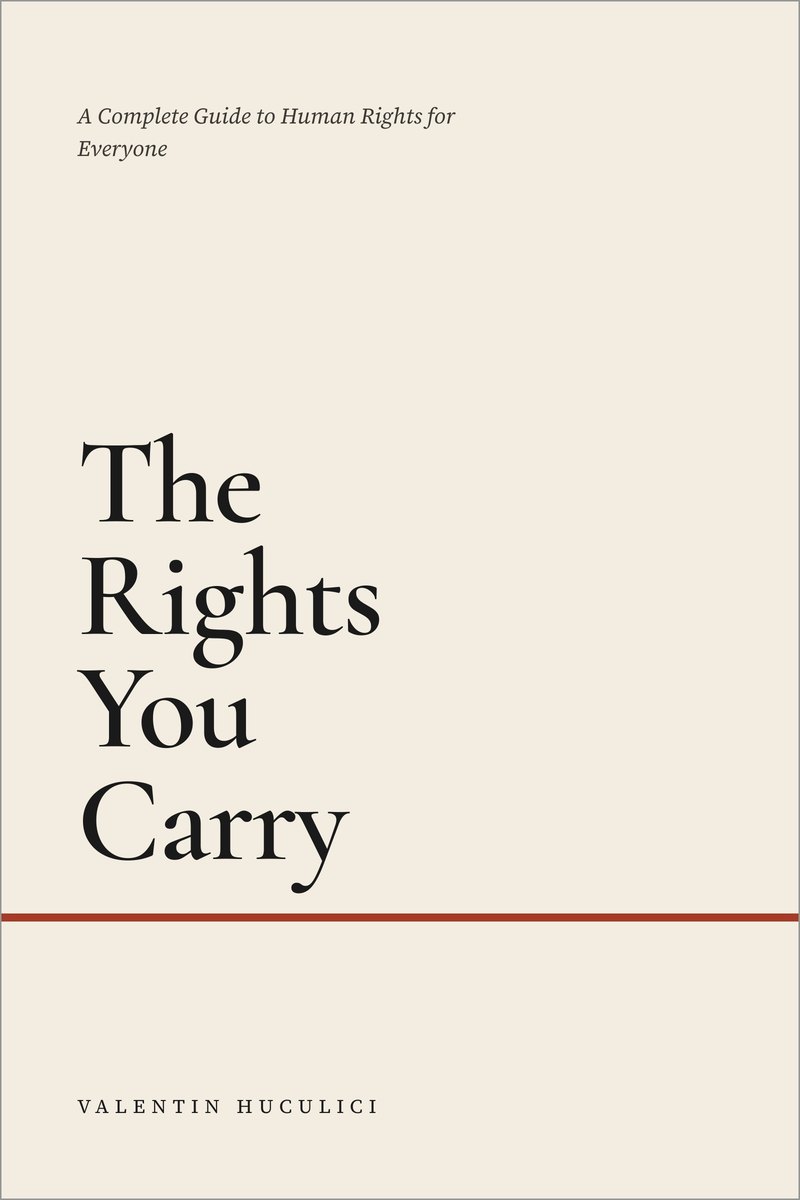
The book · Volume 1 of a series
The Rights You Carry
A Complete Guide to Human Rights for Everyone
Most people learn about their rights at the worst possible moment. This book explains, in plain language and through true stories, what each right protects, where its limits lie, and exactly what to do when it is denied. From a prisoner's pencilled petition to the US Supreme Court to a group of Swiss grandmothers who won a climate case in Strasbourg, it shows that ordinary people change the law.
Below: the contents and a free extract.
Now in Romanian
Drepturile pe care le porți cu tine
Ghid complet al drepturilor omului, pentru toată lumea
The Romanian edition, adapted for readers in Romania, with the institutions and helplines to contact there. Ebook on Apple Books (24.99 lei) and Barnes & Noble.
Who the book is for
For anyone who wants to know what rights they have and what to do when those rights are denied. You do not need to know anything about law to read it.
- For you and your family. What each right protects, where its limits lie, and the concrete steps to take when someone tells you no.
- For people who help others. Teachers, social workers, volunteers, anyone standing beside someone in a hard situation.
- For students. The history of human rights told through true stories, not definitions.
- For the doubtful. A whole chapter, “Talking to a Sceptic”, answers the most common objections.
Contents
25 chapters in five parts, plus five practical appendices. Tap a part to see its chapters.
Opening
- Dedication
- Preface
- Introduction: How to Use This Book
- Prologue: A Country Learns Its Rights
Part I: Foundations
- 1. What a Right Actually Is
- 2. Born of Catastrophe: A Short History
- 3. The Machinery
- 4. When Rights Collide
Part II: Rights of the Person
- 5. Life, and Freedom from Torture
- 6. Liberty and a Fair Trial
- 7. Privacy in a Watched World
- 8. Thought, Conscience and Religion
- 9. Speaking and Knowing
- 10. Gathering, Organising, Voting
Part III: A Life with Dignity
- 11. Equal in Dignity
- 12. The Right to Decent Work
- 13. Health
- 14. Education
- 15. A Roof, Food, Water and a Safety Net
Part IV: Rights Under Pressure
- 16. Women
- 17. Children
- 18. Refugees and Migrants
- 19. Minorities and Indigenous Peoples
- 20. Persons with Disabilities
- 21. War, Atrocity and Justice
- 22. Rights in the Digital Age
- 23. Climate and a Healthy Environment
Part V: Using Your Rights
- 24. How to Defend Your Rights
- 25. Talking to a Sceptic
- Conclusion: Rights Are Something We Do
Appendices
- A. The Universal Declaration of Human Rights in Plain Language
- B. Glossary
- C. Where to Turn
- D. Checklist for Documenting a Human Rights Violation
- E. Key Sources by Chapter
Free extract
Prologue: A Country Learns Its Rights
In the middle of December 1989, in the western Romanian city of Timișoara, a small crowd gathered outside the home of a Hungarian Reformed pastor named László Tőkés. The authorities had ordered his eviction because of his sermons, which criticised the regime. His parishioners formed a human chain around the building. Other people stopped to see what was happening. Then more came.
Within days, the crowd in Timișoara had become a revolt. On 21 December, in Bucharest, Nicolae Ceaușescu stood on the balcony of the Communist Party’s Central Committee building to address a rally organised to show that the country was behind him. For the first time in a quarter of a century, the crowd in front of him began to boo. The television broadcast was cut. The next day, he fled by helicopter from the roof of the same building. By the end of the month, more than a thousand people had been killed in the violence of those days.
On 25 December, Ceaușescu and his wife, Elena, were tried by an improvised military tribunal in a barracks in Târgoviște. The proceedings lasted about an hour. They had no real defence, no time to prepare and no possibility of appeal. They were shot immediately afterwards. Less than two weeks later, in one of its first decisions, the new government abolished the death penalty.
I begin with that week because it contains, in miniature, almost everything this book is about.
It shows what happens when a state treats its people as if they had no rights at all: the hunger, the surveillance, the fear. It shows the moment when ordinary people decide they will no longer accept it, starting not with a theory but with a human chain around one man’s door. And it shows how hard it is, even at the moment of liberation, to do justice in the right way. The first trial of the new Romania was not a fair trial. The dictator who had denied millions of people due process was himself denied it. Many Romanians, then and now, felt that he got what he deserved. But a country that wanted to become something different had to learn, slowly, that rights are not only for the people we like.
The long apprenticeship
What followed was not a fairy tale. The 1990s brought violence in the streets, poverty, corruption and deep disappointment. But they also brought, step by step, the machinery of a rights-respecting state. A new constitution in 1991 listed fundamental rights. Romania joined the Council of Europe in 1993 and ratified the European Convention on Human Rights in 1994, which meant that any person in Romania could, after exhausting national remedies, take a complaint to the European Court of Human Rights in Strasbourg. Thousands have. In 1999, a law opened the files of the former secret police, the Securitate, so that people could read what had been written about them and learn who had informed on them. In 2007, Romania joined the European Union.
I was born in Constanța, on the Black Sea coast, in January 2000, ten years after that December. I grew up in the country that came out of it, and I live today in Craiova. That country has, in other words, lived through the whole history of human rights in a single lifetime: from a system that crushed them to a system that, however imperfectly, tries to protect them. That is why Romania appears again and again in the pages that follow. Not because it is unique, but because it is a good place to see how rights are lost, how they are won back, and how much work it takes to keep them.
You will meet the children of the state orphanages that shocked the world in 1990. You will meet Valentin Câmpeanu, who died alone in a psychiatric hospital in 2004 and whose case changed the law of Europe. You will stand in Victoria Square in February 2017, when hundreds of thousands of people held up the lights of their phones. You will see how, during the pandemic of 2020, more than three hundred thousand fines were handed out under emergency rules that the Constitutional Court later found unconstitutional. You will follow the debate over the annulled presidential election of 2024.
But this is not a book about Romania. Most of its stories come from elsewhere: from Paraguay and South Africa, Bangladesh and Kenya, Switzerland and the Philippines. The Romanian thread is simply a reminder that human rights are not something that happens far away, to other people. They happen to all of us, in the places we live.
A promise kept and broken
The Universal Declaration of Human Rights was adopted forty-one years before that December in Timișoara. Romania’s government had promised, many times, to respect the rights it lists. It had signed the treaties. Its own constitution contained beautiful words. None of that protected anyone, because the words were not known, not claimed and not enforced.
The lesson I take from that is simple, and it is the reason for this book. Rights written on paper are a promise. Whether the promise is kept depends on whether people know what was promised to them, and whether they are prepared to insist on it.
So let us begin with what was promised.
About the author
Valentin Huculici is an author and human rights educator and the founder of the publication Dreptul la Adevăr. Read more about him.